SMM, February 23: Recently, data released by the China Association of Automobile Manufacturers (CAAM) showed that in January 2025, China's NEV production and sales reached 1.015 million units and 944,000 units, respectively, up 29% and 29.4% YoY. NEV sales accounted for 38.9% of total new car sales. In the overall automotive market, China's automobile production and sales in January reached 2.45 million units and 2.423 million units, respectively, with production up 1.7% YoY and sales down 0.6% YoY. Automobile exports totaled 470,000 units, up 6.1% YoY.
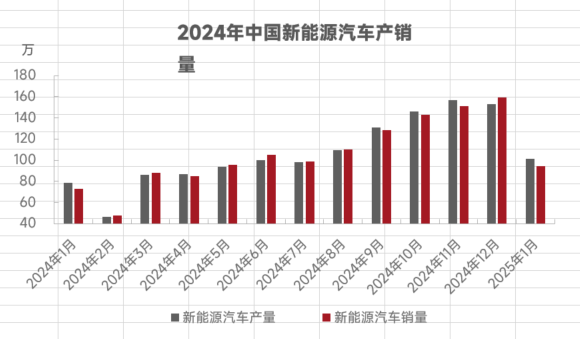
The rapid growth in NEV production and sales can be attributed to multiple factors. From a policy perspective, the government has continuously increased its support for the NEV industry by introducing a series of favorable policies, such as car purchase subsidies, tax reductions, and preferential car purchase quotas, effectively reducing consumers' car purchase costs and stimulating market enthusiasm. For instance, in some regions, NEV purchase subsidies can reach up to 15% of the car price, attracting many consumers to NEVs.
In terms of technological innovation, NEV technology has made continuous breakthroughs. Battery driving range has significantly improved, with many NEVs now easily achieving a range of over 700 kilometers. Charging speed has also greatly increased, with the ability to charge from 30% to 80% in just 30 minutes, alleviating consumers' range anxiety. Meanwhile, autonomous driving technology is gradually maturing, with features such as automatic parking and adaptive cruise control making the driving experience more convenient and comfortable, attracting numerous consumers.
The growing environmental awareness among consumers is another important factor. As society places greater emphasis on environmental protection, more consumers are inclined to choose environmentally friendly travel options. The zero-emission or low-emission characteristics of NEVs align with this demand. Additionally, the variety of NEV brands continues to expand, with increasingly diverse product offerings ranging from economical and practical models to high-end luxury models, meeting the personalized needs of different consumer groups.
Regarding future NEV sales, the China EV100 has made an optimistic forecast. It is expected that by 2025, China's automobile market sales will reach approximately 32 million units, with the domestic market accounting for about 26 million units, growing at a rate of 3%. In the NEV sector, including exports, sales are expected to reach 16.5 million units, with a growth rate of nearly 30%, while domestic demand is projected to reach 15 million units, with a penetration rate exceeding 55%. Among these, plug-in hybrid and range-extended EVs are expected to become key contributors to the growth in NEV sales.
》Apply for a Free Trial of the SMM Metal Industry Chain Database
The growth in NEV sales has had a multifaceted impact on the rare earth industry. From the demand side, rare earth permanent magnets are core materials for NEV motors, and the continuous expansion of the NEV market has significantly boosted the demand for rare earth permanent magnets. The "Implementation Plan for Promoting High-Quality Development of the NEV and Power Battery Industries," jointly issued by the National Development and Reform Commission (NDRC) and other departments, sets a target of 10 million annual NEV sales by 2025. If achieved, the demand for rare earth permanent magnets will see significant growth, providing a vast market space for the rare earth industry. Historical data shows that from 2020 to 2024, the growth rate of NEV production and sales became a key anchor for rare earth demand, with end-use demand growth closely aligned with rare earth prices. In 2020-2021, NEV demand surged, but supply growth remained relatively stable, leading to an imbalance that drove rare earth prices sharply higher. However, from 2022 to H1 2024, domestic quotas increased significantly while NEV demand growth slowed, causing rare earth prices to decline sharply. By H2 2024, the growth rate of the second batch of rare earth quotas slowed, coupled with the peak season for NEV production and sales, improving the supply-demand relationship and gradually stabilizing rare earth prices. With the continued growth in NEV sales, the supply-demand relationship in the rare earth industry will be further reshaped, exerting a lasting impact on rare earth prices.
The continued growth in demand for NEVs and wind power, along with the effective increase in equipment replacement demand for industrial motors, is expected to elevate the demand curve for 2025-2026. This may succeed new energy as a major source of demand growth for rare earths. Additionally, the expanding application scenarios for robotics are expected to create new development opportunities for the rare earth magnet industry in 2025.